The research and educational seminar “Mathematical Logic and Category Theory” (at the International Laboratory for Logic, Linguistics and Formal Philosophy, HSE University) is aimed at the joint study of the fundamentals and current results in the fields of categorical logiс, foundations of mathematics, type, proof, and model theories. Special attention is given to the study of problems and approaches at the intersection of mathematics, formal philosophy, logic, and theoretical computer science. The seminars are intended to introduce the basic concepts and topics of mathematical disciplines directly related to HoTT, MLTT, category theory, modal logic, and formal arithmetic. Participation does not presuppose special knowledge in the above-mentioned fields. The seminar is conducted in Russian and English.
The seminar has two types of activities:
Seminar organizers: Ramazan Ayupov (HSE University) & Arnold Grigorian (MIPT, LMU München).
If you would like to become a participant in the seminar, give a talk, or simply receive announcements, please write to one of the following emails:
ramazan.i.ayupov [at] gmail [dot] com
The seminar’s chat on Telegram (rus).
Physical address: 105066, Moscow, Staraya Basmannaya, 21/4, room A-117.
UPCOMING EVENTS
TBA
RECENT TALKS
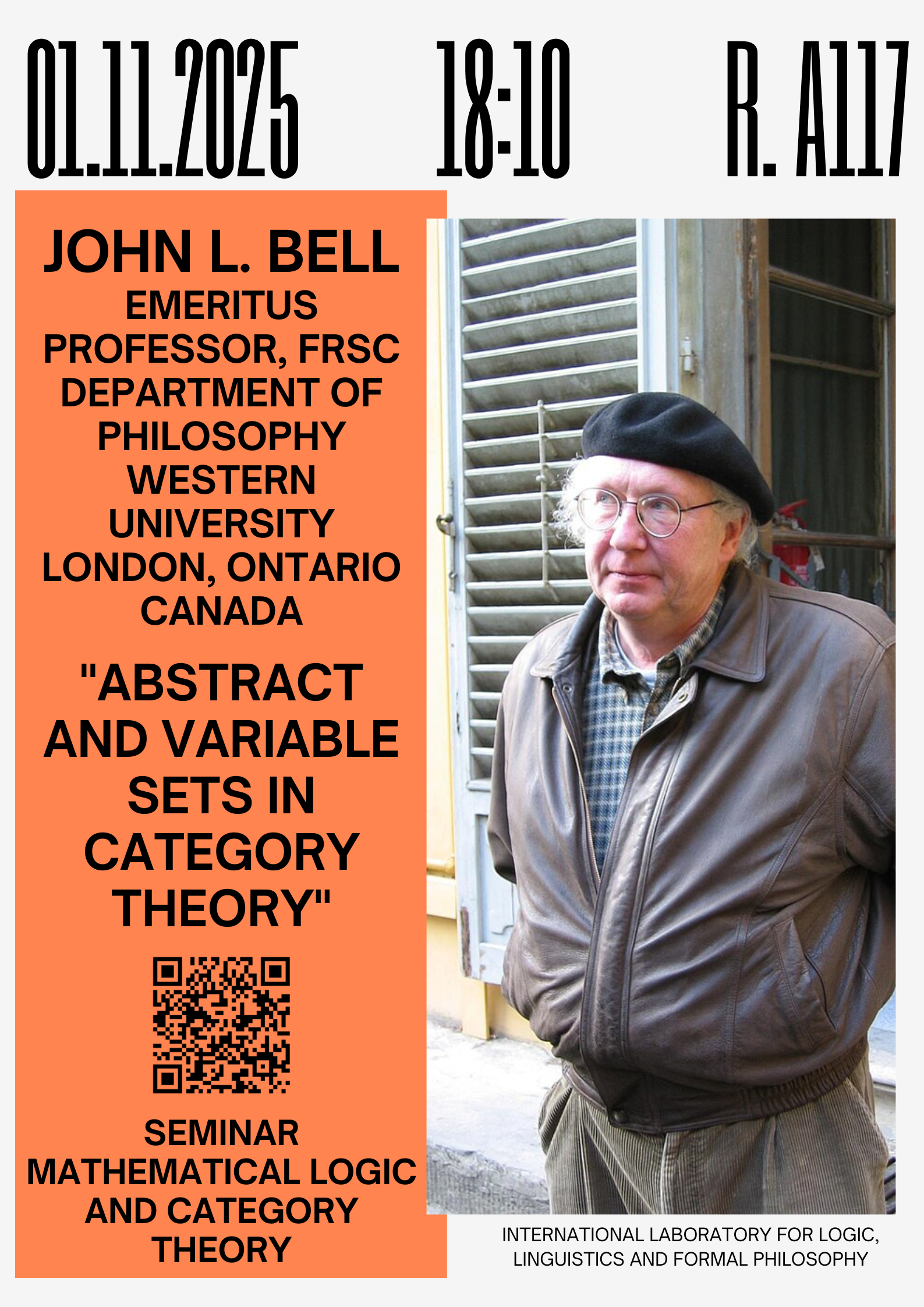
[November 01, 2025] (eng, link / text)
John L. Bell (Emeritus Professor, FRSC Department of Philosophy Western University London, Ontario Canada)
— Abstract and Variable Sets in Category Theory
In 1895 Cantor gave a definitive formulation of the concept of set, namely,
A collection to a whole of definite, well-differentiated objects of our intuition or thought.
Let us call such a collection a concrete set. More than a decade earlier, Cantor had introduced the notion of cardinal number by appeal to a process of abstraction:
If we abstract not only from the nature of the elements of a set, and also from the order in which they are given, then there arises in us a definite general concept which I call the cardinal number of the set.
Lawvere has suggested calling Cantor’s cardinal numbers abstract sets. An abstract set may be considered as arising from a concrete set when each element has been purged of all intrinsic qualities aside from the quality which distinguishes that element from all the others. An abstract set is thus an embodiment of pure discreetness.
In my talk I will describe how category theory provides the natural framework for understanding abstract sets, conceived of as static or as undergoing change.
(poster)
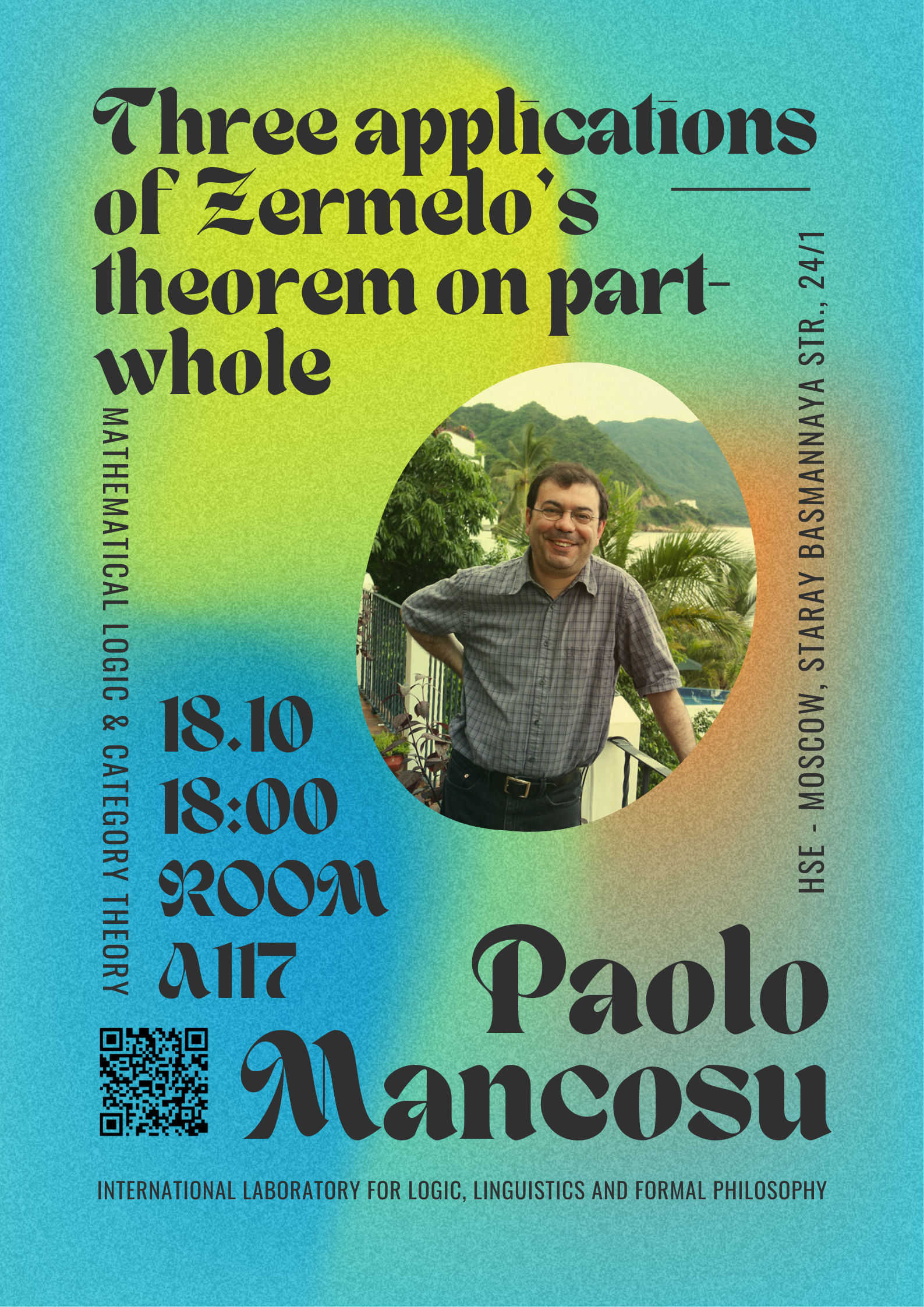
[October 18, 2025] (eng, link / slides)
Paolo Mancosu (Willis S. and Marion Slusser Professor of Philosophy, Department of Philosophy, UC Berkeley)
— Three applications of Zermelo’s theorem on part-whole
The aim of the presentation is to give a general overview of the application of a result by Ernst Zermelo to three very different areas of investigation: abstraction principles in neologicism, the axiom of choice in second-order logic, and regularity properties in probability theory. The talk is based on three articles that have recently appeared (see bibliography).
Bibliography:
(poster)
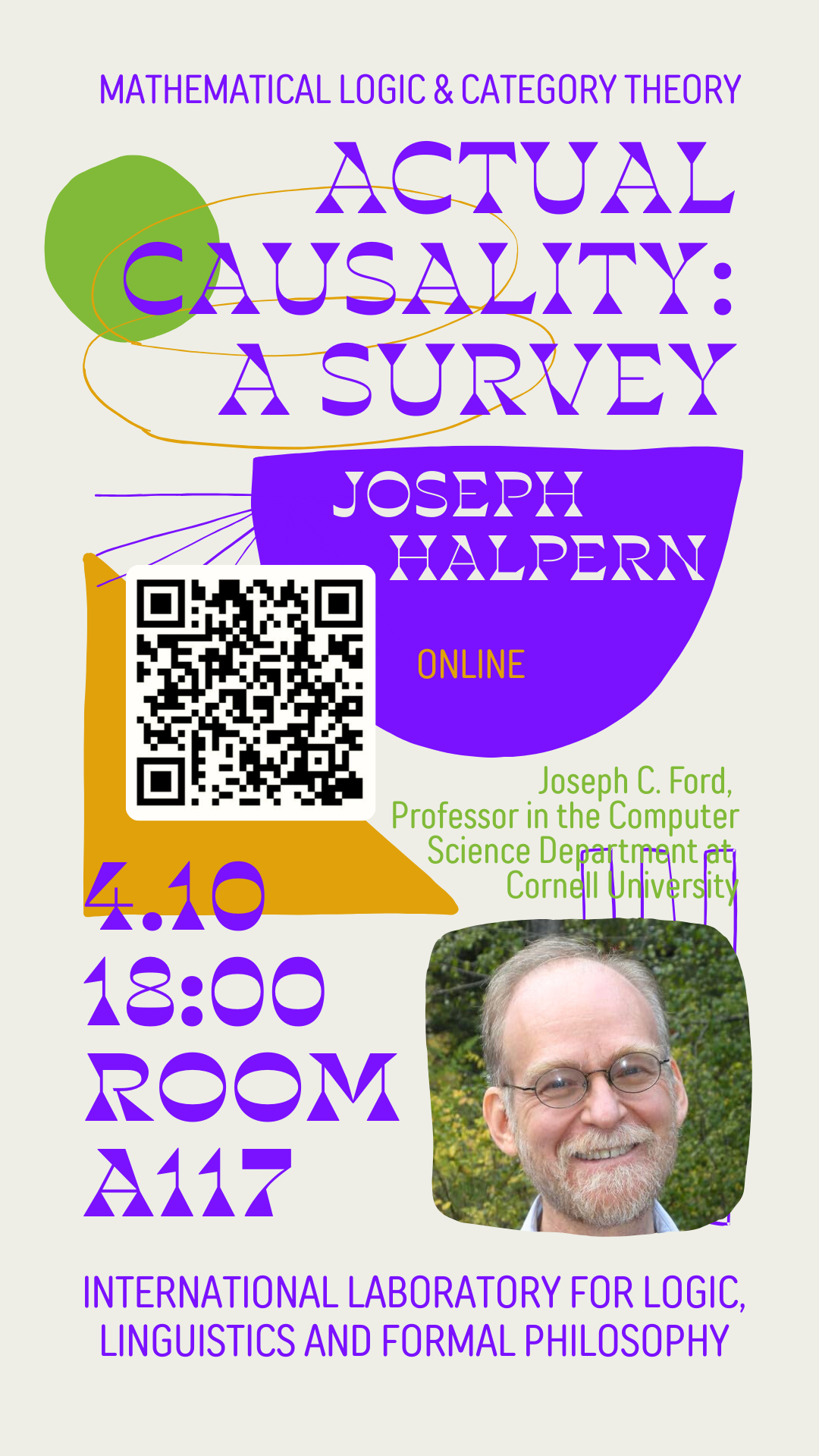
[October 04, 2025] (eng, link / slides)
Joseph Y. Halpern (Joseph C. Ford Professor in the Computer Science Department at Cornell Univeesity)
— Actual Causality: A Survey
What does it mean that an event C “actually caused” event E? The problem of defining actual causation goes beyond mere philosophical speculation.
For example, in many legal arguments, it is precisely what needs to be established in order to determine responsibility. (What exactly was the actual cause of the car accident or the medical problem?) The philosophy literature has been struggling with the problem of defining causality since the days of Hume, in the 1700s. Many of the definitions have been couched in terms of counterfactuals. (C is a cause of E if, had C not happened, then E would not have happened.) In 2001, Judea Pearl and I introduced a new definition of actual cause, using Pearl’s notion of structural equations to model counterfactuals. The definition has been revised twice since then, extended to deal with notions like “responsibility” and “blame”, and applied in databases and program verification. I survey the last 15 years of work here, including joint work with Judea Pearl, Hana Chockler, and Chris Hitchcock. The talk will be completely self-contained.
(poster)
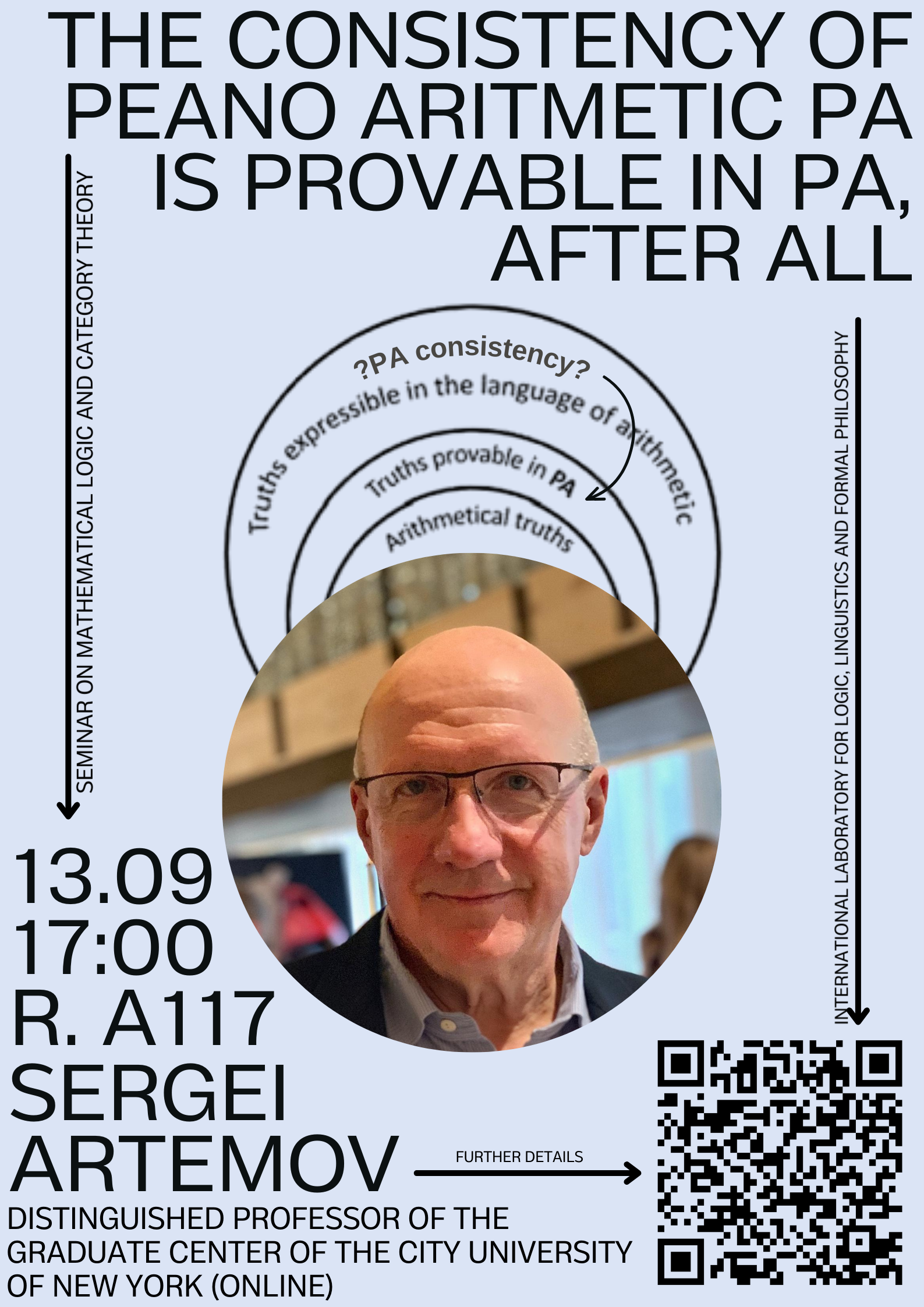
[September 13, 2025] (rus, link / slides)
Sergei N. Artemov (Distinguished Professor of the Graduate Center of the City University of New York)
— The consistency of Peano Arithmetic PA is provable in PA, after all
We show that the famous consistency formula Con(PA) for Peano Arithmetic PA, “no x is a code of a derivation of (0=1),” is strictly stronger in PA than the statement “PA is consistent.” Hence, despite the widespread belief, the unprovability of Con(PA) in PA does not yield the unprovability of consistency. Furthermore, we demonstrate that “PA is consistent” is provable in PA. These findings apply to a broad class of formal theories, including ZF set theory.
We also discuss the potential impact of these findings on the foundations of mathematics and the theory of cognition.
References:
(poster)
[February 8, 2025] (rus, link)
Andrei Rodin (Archives Henri-Poincaré, university of Lorraine, France)
— Vladimir Voevodsky on the concept of mathematical structure
In our email correspondence from 2016, Vladimir Voevodsky proposed an original concept of mathematical structure. This concept was motivated by his work in homotopy type theory on the one hand, and his reading of Proclus’s commentary on Euclid’s definition of a plane angle (Definition 1.8 of the “Elements”) on the other. In my presentation, I will introduce Vladimir’s conception of mathematical structure, compare it with standard conceptions, and touch upon some of the questions Vladimir raised in our correspondence.
This presentation is based on the article arXiv:2409.02935.
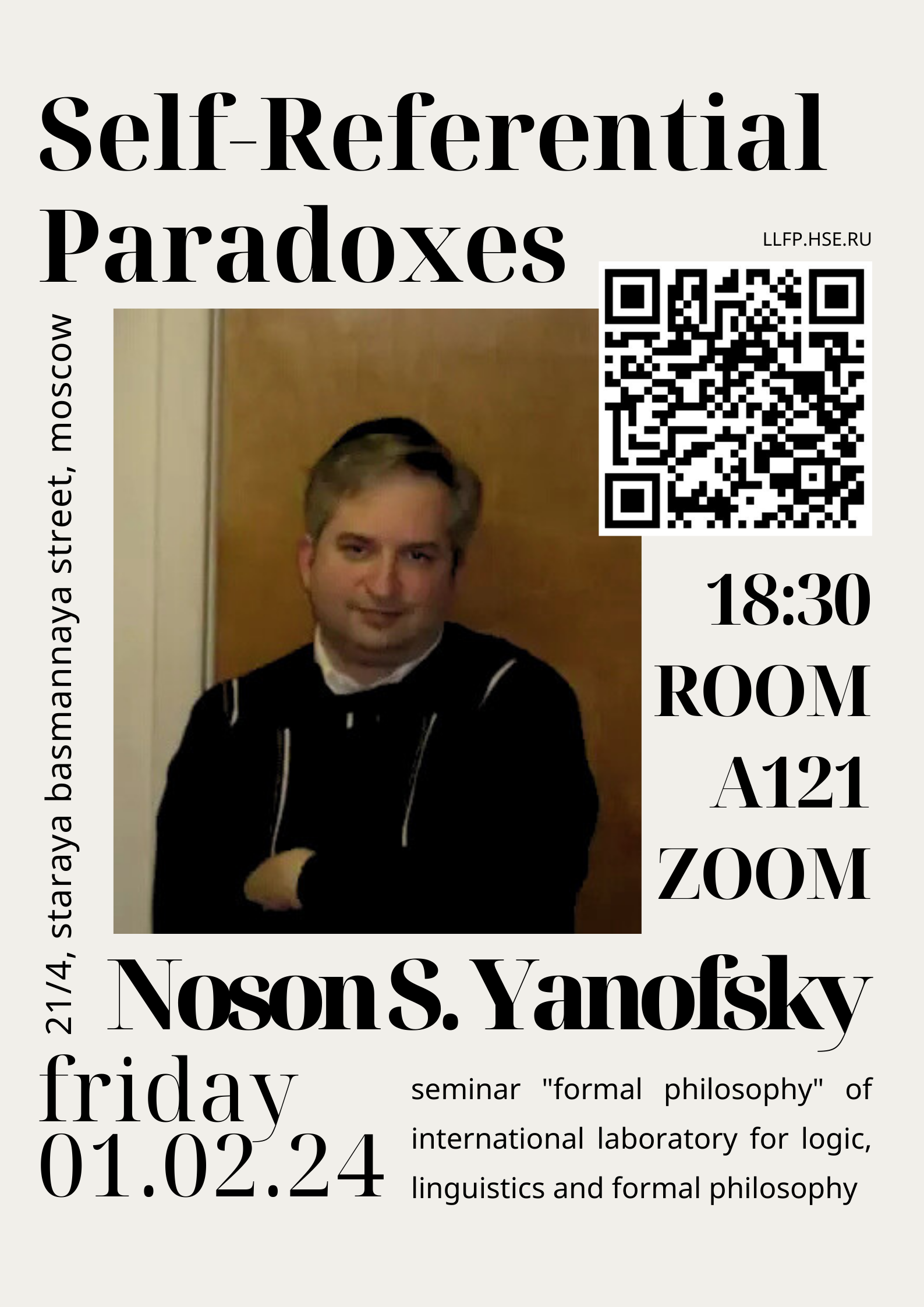
[January 31, 2025] (eng, link)
Noson S. Yanofsky (Professor of Computer and Information Science at Brooklyn College and The Graduate Center, CUNY)
— Self-Referential Paradoxes
Over the past 150 years, some of the most profound and influential theorems in mathematics and computer science have emerged from self-referential paradoxes. These theorems deal with systems that exhibit self-reference, challenging our understanding of fundamental concepts. This presentation will explore:
Remarkably, these diverse theorems, along with several others, can be understood as manifestations of a single, elegant theorem from basic category theory. This presentation will elucidate this theorem and demonstrate its various instances.
(poster)